Rental Property Tax Deductions Checklist: Schedule E Records to Gather
Rental property tax deductions checklist: gather Schedule E receipts, statements, and workpapers by property, then flag tax questions for your preparer.
By Ultimate Rental Property Tracker by Cosmo Suite · Editorial policy
Published · 8 min read
Rental Property Tax Deductions Checklist: Schedule E Records to Gather
General information, not tax or legal advice. Ask your tax preparer or a local attorney about your situation.
Tax time is coming up, and the insurance statement may be in email, the plumber's receipt in a drawer, or the property tax bill in last year's folder. Schedule E groups expenses by category, so start by finding the records behind each amount.
This rental property tax deductions checklist helps you gather expense records by property and year. It follows lines 5 through 19 of the 2025 Schedule E, the latest finalized form and instructions available when checked on November 3, 2026. The categories help organize costs; your tax preparer can decide how the rules apply to your situation.
Schedule E is the IRS form used to report certain rental income and expenses, including rental real estate in Part I. The IRS instructions explain which records to gather and which form year to use.
What records should you gather for each Schedule E expense?
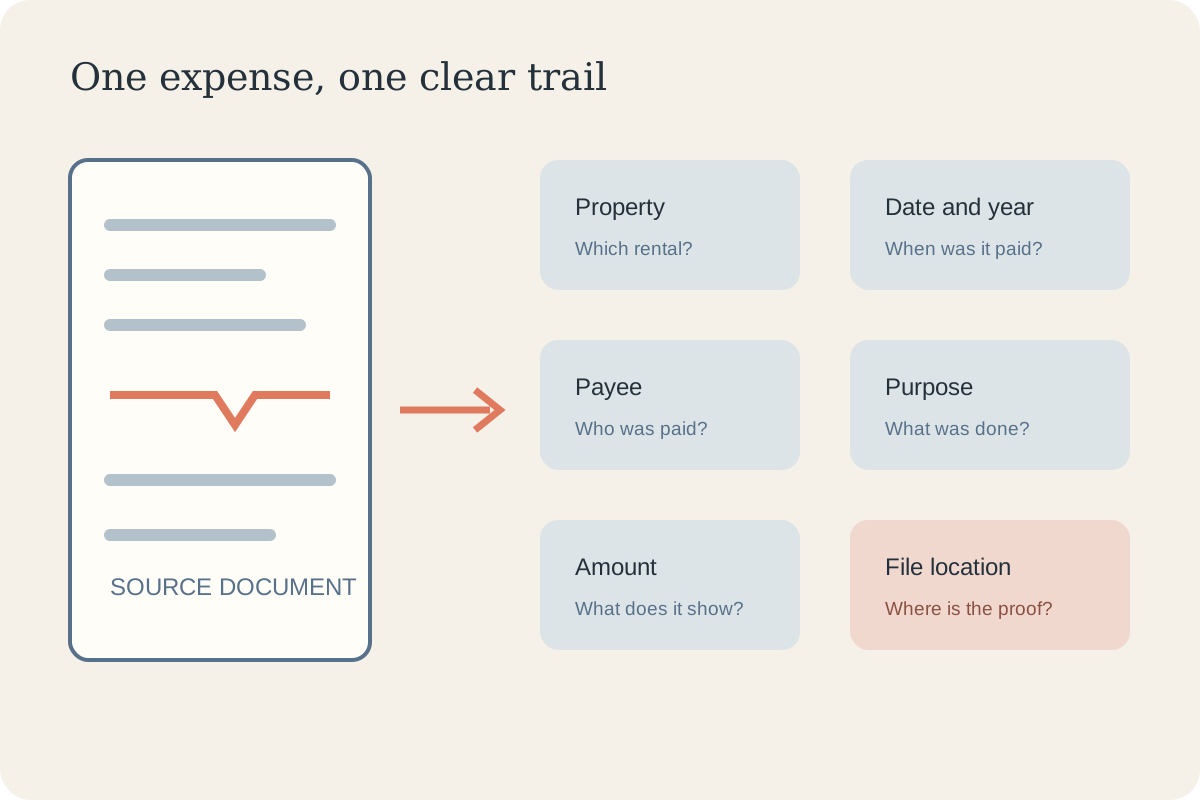
For each Schedule E expense, gather the source document and identify the property, tax year, payee, amount, and payment purpose. This list follows the 2025 form. Check the Schedule E for your filing year because line details can change.
| Schedule E line | Expense category | Record to gather |
|---|---|---|
| 5 | Advertising | Listing invoice, receipt, and property covered |
| 6 | Auto and travel | Mileage or travel log, date, destination, and rental purpose |
| 7 | Cleaning and maintenance | Itemized receipt or invoice describing the work |
| 8 | Commissions | Agent agreement, statement, and payment record |
| 9 | Insurance | Policy, premium bill, and proof of payment |
| 10 | Legal and other professional fees | Engagement letter and itemized invoice |
| 11 | Management fees | Management contract, monthly statement, and year-end summary |
| 12–13 | Mortgage interest and other interest | Form 1098, lender statement, loan record, or interest statement |
| 14 | Repairs | Work order, itemized invoice, date, and property |
| 15 | Supplies | Receipt and note describing the supplies and use |
| 16 | Taxes | Property tax bill, payment confirmation, or other tax statement |
| 17 | Utilities | Utility bill, payment record, and allocation note if shared |
| 18 | Depreciation or depletion | Preparer's calculation and supporting workpapers |
| 19 | Other expenses | Itemized source document and a plain description of the cost |
The 2025 Schedule E instructions list these categories and explain how to enter rental expenses by property. Save the source document with each total so you can see what you paid and what the work involved.
Do you have the bill and the payment record? Keep both when available. The bill explains the charge, and the payment record shows when it cleared.
If you rent only part of a home or use the property personally, keep the full expense record and mark the facts for review. The rental portion may need to be separated from personal use. Do not remove the personal portion from the original bill or make a tax decision from the category label.
The lines also distinguish current expense categories from depreciation. Keep the property and improvement records that support the depreciation workpaper with the tax-year folder. Your preparer can tell you which records apply and whether an item needs treatment outside the expense categories shown here.
Make every cost traceable
For each transaction, record the property, tax year, date, payee, amount, purpose, category, and file location so you and your preparer can find the source later. Add a note for any question that needs review.
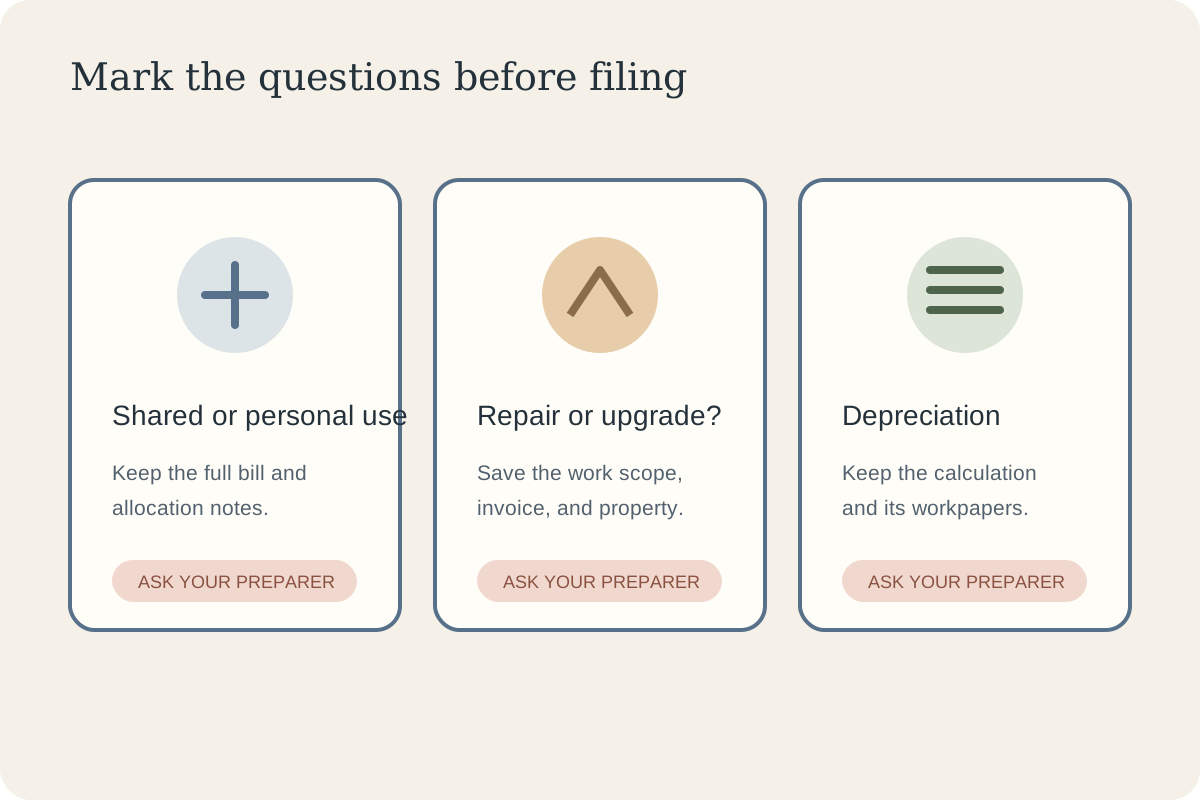
For a plumbing job, save the invoice with the rental address, work date, contractor, amount, and job description. If one bill covers several properties, keep the full bill with your allocation notes. Ask your tax preparer to review the method.
Keep the rental portion separate from personal costs when a property serves both purposes. The IRS explains that the part of expenses applying to a rented portion may be treated differently from the personal-use portion. The details depend on your situation. Save the full bill and the calculation rather than overwriting the source amount.
Do two rentals share a bill? Keep the full bill and note how you split it. If you own several properties, keep each property's total separate before combining figures for a return. A rental property spreadsheet organized by property and expense can hold the logs in one place. Folders or another spreadsheet work too.
Name each file so the property and year are easy to recognize. For example, a folder structure might start with the property address, then the year, then a category such as utilities or repairs. Store emailed receipts with scans of paper invoices. If a record applies to several properties, keep one original and note its location in each relevant folder.
Which documents should you gather for each expense group?
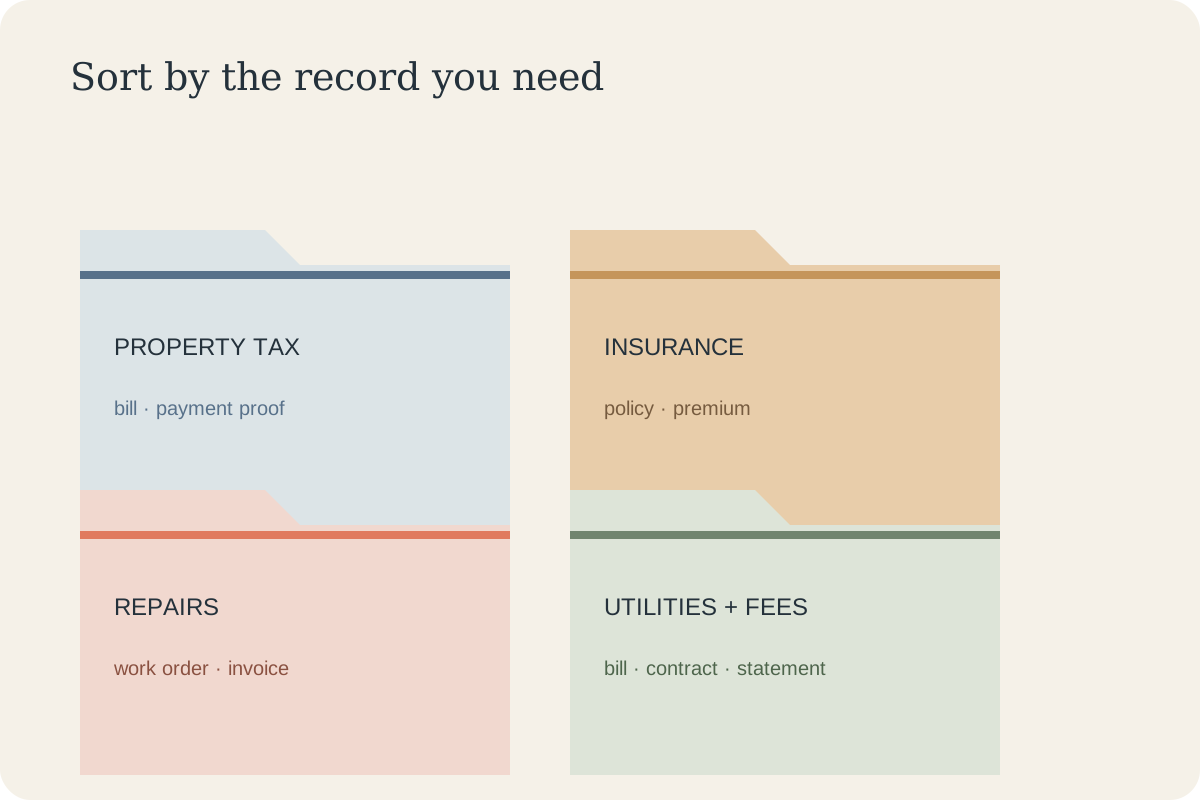
Gather enough detail to explain each charge. One document may support more than one expense category. These groups can help you scan the year's folder before meeting with a preparer.
Listings and professional services: Find advertising invoices and payment records. For legal, accounting, or other professional fees, keep the engagement letter and itemized bill. A short note can identify the property or issue connected to the work.
Travel and vehicle costs: Collect mileage logs, dates, destinations, and a note about the rental activity. If a trip combined personal and rental purposes, flag it for review. The IRS recordkeeping guidance for rental real estate discusses records used to support rental income and expenses.
Cleaning, maintenance, and repairs: Keep work orders, receipts, and invoices that say what was done. “Repair” may not tell your preparer enough. If the invoice is unclear, ask the contractor for an itemized description. Keep related photographs or messages with the invoice.
Insurance, commissions, and management: Gather policies and premium statements, agent agreements, management contracts, and the related statements. Keep the property's name or address visible on each record. If one document covers more than one property, attach a note showing how you separated the amounts.
Interest, taxes, and utilities: Look for lender statements and Form 1098, property tax bills and payment confirmations, and utility statements. Keep an allocation note for a shared service or mixed-use property. The IRS Publication 527 discusses rental expenses, including interest, taxes, insurance, repairs, and utilities.
Supplies and other costs: Save itemized receipts and describe the purchase. “Hardware store” names the payee, not the item. If a cost does not fit a named line, note why you put it under other expenses. Ask your preparer to review it.
Keep source documents in their original form when possible. A payment confirmation shows when money moved, while an itemized invoice describes the work or purchase. A statement may show the date and total, while the bill gives a service period or address, so keep both when they add different details.
Is it a repair or an improvement?
A receipt alone cannot answer that. Publication 527 explains that some costs may need to be capitalized instead of treated as current expenses. A capital improvement is work that betters a property, restores it, or adapts it to a new use. Keep the invoice, the property's condition before the work, what changed, and the date, then ask your tax preparer how the rules apply.
Depreciation is the annual deduction for the cost or basis of property over its useful life. Do not calculate it from a receipt total or a guess. Save the depreciation schedule or workpaper that supports the figure entered on the form. The IRS Topic 414 directs readers to Publication 527 for details about rental income, expenses, and depreciation.
Mark shared costs, personal use, a large renovation, an insurance reimbursement, and unclear payments for your preparer's attention. These details can affect which records are needed and how an amount is reported. If your preparer adjusts a category, keep the original record and note the change and its source. For example, keep a note with an insurance reimbursement that points to the related repair invoice.
Finish with a year-end record check
Before your appointment, review one property at a time. Check each cost's date, amount, purpose, and source, then compare your expense list with statements and invoices. Note missing records and payments made by someone else. The IRS rental income and expense guidance covers common categories and points to material on special cases.
Check these items:
- Match the document to the right property and tax year.
- Check that the amount in your summary agrees with the source.
- Add an explanation for shared bills or mixed-use costs.
- Mark repairs, improvements, depreciation, and unusual payments for review.
- Keep the original records with the summary you bring to your preparer.
Compare your records with the IRS 2025 Schedule E form and its instructions, then use the form for the year you file. The checklist organizes your records; your tax preparer can decide how the rules apply.
How Ultimate Rental Property Tracker fits
Ultimate Rental Property Tracker is a Google Sheets and Excel workbook with 15 tabs. They include Expense Log, Maintenance & Repairs, Properties, Mileage Log, and Schedule E Summary. The contents list says it supports up to 50 properties. It includes a sample copy, a clean copy, and a short PDF guide. The Schedule E Summary sorts your figures into form lines. It does not decide deductibility, calculate depreciation, give tax advice, or file a return.
The workbook has no bank link, rent collection, or tenant portal. Its contents may suit you if a ready-made rental property records spreadsheet would help organize the records. Keep the source receipts and statements for your preparer.
We checked the IRS materials on November 3, 2026. The Ultimate Rental Property Tracker team prepared this guide. Its editorial policy explains source checks and corrections. Check the IRS page for your tax year. Ask a tax preparer to review decisions about your property.
For a broader record system, see the rental property spreadsheet guide. The Schedule E instructions guide and Schedule E worksheet record map cover the income side and the form layout.
Frequently asked questions
What expenses should a landlord gather for Schedule E?
Gather records for the expense categories shown on the Schedule E for your tax year, such as insurance, interest, repairs, taxes, and utilities. The form category does not decide whether a specific cost qualifies. Keep the source document and ask your tax preparer about its treatment.
What receipts should I keep for rental property taxes?
Keep invoices, receipts, bills, statements, contracts, and workpapers that show the property, date, amount, payee, and purpose. Record where each file is stored. Your tax preparer can tell you what documentation applies to your circumstances.
Are rental property repairs deductible?
It depends on the work and the tax rules. Save an itemized invoice that describes what was repaired, where, and when. Repairs and improvements can have different treatment, so ask your tax preparer before reporting the cost.
Can I deduct rental property expenses used for personal purposes too?
Shared or mixed-use expenses may need an allocation, and the method depends on the facts and applicable rules. Keep the original bill and a note showing how you calculated any rental portion. Have your preparer review it.
Can a spreadsheet calculate my rental property deductions?
A spreadsheet can organize amounts and source records. It cannot decide which costs qualify, calculate depreciation, or file a return. Use the IRS instructions for the tax year you file and ask a tax preparer about your situation.
When should I organize rental expenses for Schedule E?
Add each record during the year when possible, then reconcile the property and tax-year totals before preparing your return. Keep the underlying receipts, invoices, and statements with the summary so the figures can be traced and reviewed.
Sources
Keep reading
Schedule E and Tax Time
Schedule E Instructions for Rental Property: What Records Go on Each Line?
Schedule E instructions for rental property, with a 2025 line-by-line record guide, notes on loss limits, and a list of what to bring to your tax preparer.
· 8 min read
Schedule E and Tax Time
Schedule E Worksheet for Rental Property: What to Gather
Use this Schedule E worksheet guide to match rental property income and expense lines to the records you can gather for your tax preparer.
· 7 min read
